Introduction
Sales commissions directly influence how sales teams prioritize opportunities, achieve targets, and generate revenue. Yet for many organizations, calculating and tracking commissions remains a complicated manual process involving spreadsheets, CRM exports, emails, and multiple approval steps.
Sales Commission Software is designed to simplify this process by automating commission calculations, consolidating performance data, and giving sales teams greater visibility into their earnings.
Before purchasing a platform, however, organizations need to understand what commission software actually does, what features matter, how implementation works, and what the overall investment may involve.
What Is Sales Commission Software?
Sales commission software automates the processes involved in managing sales compensation.
Depending on the platform, capabilities can include:
Commission plan creation
Commission calculations
Quota tracking
Sales performance monitoring
Payout management
Adjustments
Dispute management
Reporting
Approval workflows
Instead of manually calculating commissions after every sales cycle, organizations can establish rules within a centralized platform.
Why Companies Are Moving Away From Manual Commission Tracking
Spreadsheets Create Operational Challenges
Spreadsheets can become increasingly difficult to manage as sales organizations grow.
A single commission workbook may contain thousands of rows, complex formulas, manual adjustments, and data from multiple systems.
This can lead to:
Formula errors
Incorrect payouts
Duplicate records
Delayed commission statements
Difficult audits
Limited visibility
Commission Tracking Software can help replace fragmented spreadsheets with a centralized process.
Important Features to Look For
1. Automated Commission Calculations
The software should automatically calculate commissions based on configured compensation rules.
This is particularly important when plans include multiple tiers, accelerators, thresholds, bonuses, or exceptions.
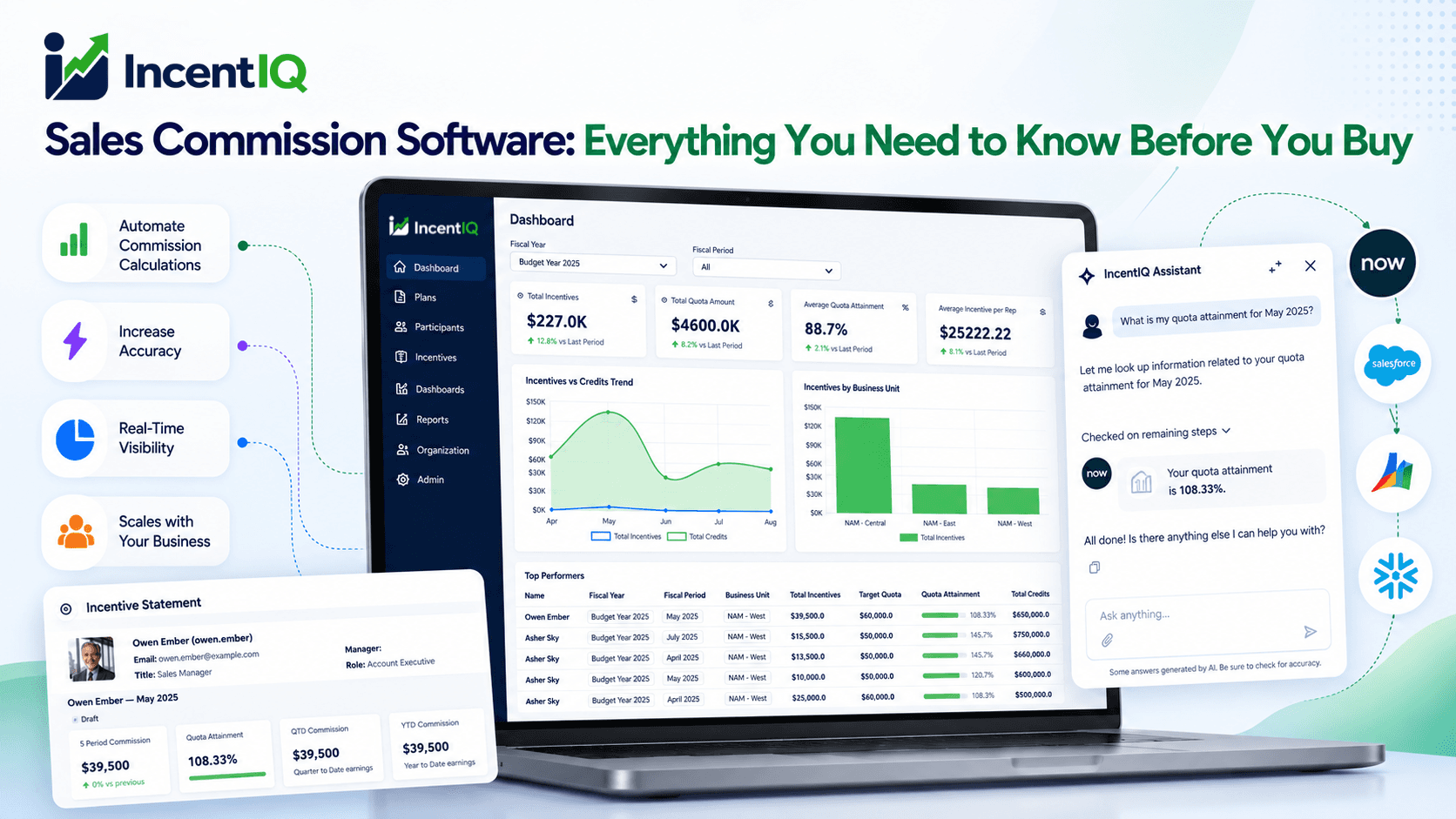
2. Real-Time Performance Visibility
Sales representatives should not have to wait until the end of the month to understand their performance.
Dashboards can provide visibility into:
Quota attainment
Sales performance
Commission earned
Incentive progress
Expected payouts
This allows salespeople to better understand how their activities affect compensation.
3. Commission Plan Management
Compensation teams need flexibility when creating or updating plans.
Look for functionality that supports different plans for different:
Roles
Regions
Products
Territories
Business units
4. Dispute Management
Commission disputes are common when sales representatives cannot understand how a payout was calculated.
A structured dispute workflow allows employees to raise questions while giving managers and finance teams a controlled process for reviewing and resolving them.
5. Reporting and Analytics
Finance and sales leadership need more than payout totals.
They may need to analyze:
Compensation expenses
Plan effectiveness
Quota attainment
Commission trends
Sales performance
Incentive ROI
Analytics can help organizations identify whether compensation plans are actually driving desired sales behavior.
How Much Does Sales Commission Software Cost?
Understanding the Total Investment
Pricing varies significantly between platforms. Costs may depend on:
Number of users
Number of plans
Transaction volume
Integrations
Implementation requirements
Customization
Reporting capabilities
Enterprise requirements
Organizations should therefore evaluate total cost of ownership, rather than comparing subscription prices alone.
Implementation, integrations, data migration, training, administration, and ongoing support can all affect the overall investment.
Why Integration Matters
Connecting CRM, HR, Finance, and Compensation
Commission calculations depend on accurate data.
A modern platform should be capable of working with existing enterprise systems rather than forcing teams to maintain separate datasets.
For organizations already using ServiceNow, an incentive management solution built natively on the platform can provide an opportunity to connect incentive workflows with the broader ServiceNow ecosystem.
How IncentIQ Fits Into Modern Commission Management
IncentIQ provides an AI-first Incentive Compensation Management approach designed for enterprise organizations.
Built natively on ServiceNow, IncentIQ is designed to bring incentive compensation processes into an enterprise platform where organizations can manage workflows, approvals, data, and employee experiences.
This can help organizations move beyond disconnected commission spreadsheets toward a more centralized approach to compensation management.
Conclusion
Choosing Sales Commission Software is an important technology decision for growing sales organizations. The right platform should provide more than automated calculations. It should deliver transparency, reliable Commission Tracking Software, flexible plan management, integrations, reporting, governance, and scalability.
For enterprises seeking to modernize sales compensation, IncentIQ combines an AI-first approach with ServiceNow-native incentive compensation management to help organizations build a more connected and automated commission process.
The takeaway
IncentIQ brings incentive data, calculations, and AI into one governed system on  — so compensation is transparent, intelligent, and trusted at enterprise scale.