Introduction
Managing sales incentives effectively is critical for organizations that want to motivate sales teams while maintaining accurate, transparent, and predictable compensation. As sales organizations grow, managing commissions and incentive plans through spreadsheets can become increasingly difficult. Complex formulas, changing compensation rules, multiple approval levels, and manual calculations can create errors and delays.
Sales Incentive Compensation Software provides a centralized way to design incentive plans, automate calculations, track performance, and improve payout accuracy. However, with many solutions available, selecting the right platform requires more than comparing features and pricing.
For enterprises, the right Sales Incentive Software should support scalability, integration, automation, governance, and the specific needs of finance, HR, sales operations, and employees.
Why Businesses Need Sales Incentive Compensation Software
Moving Beyond Spreadsheet-Based Processes
Spreadsheets may work for simple commission structures, but they become difficult to maintain when organizations introduce multiple plans, territories, quotas, accelerators, bonuses, or exceptions.
Manual processes can result in:
Calculation errors
Duplicate data
Delayed payouts
Version-control problems
Limited visibility
Difficult dispute resolution
Sales incentive software centralizes these processes and creates a more structured compensation workflow.
Supporting Complex Compensation Plans
Enterprise organizations often have different incentive structures for different roles, regions, products, and sales teams. A capable platform should accommodate these variations without requiring constant manual intervention.
Key Factors to Consider When Choosing Sales Incentive Software
1. Incentive Plan Flexibility
Look for software that can handle different commission rates, quotas, accelerators, bonuses, thresholds, clawbacks, and exception rules.
The platform should allow compensation teams to modify plans without rebuilding the entire system.
2. Automated Commission Calculations
Automation is one of the most important capabilities to evaluate. The platform should calculate incentives consistently based on predefined rules and performance data.
This reduces manual calculations and helps compensation teams spend less time validating spreadsheets.
3. Integration Capabilities
Your incentive platform should connect with the systems already used by the organization.
Important integrations may include:
CRM platforms
HR systems
ERP systems
Payroll systems
Finance applications
Data warehouses
Integration helps create a reliable flow of performance and employee data.
4. Transparency and Employee Visibility
Sales representatives should be able to understand how their incentives are calculated.
A strong platform can provide visibility into:
Performance
Attainment
Commission earnings
Bonus eligibility
Payout status
Adjustments
Greater transparency can reduce disputes and improve trust.
5. Security and Governance
Compensation data is sensitive. Organizations should evaluate role-based access, audit trails, approval workflows, and data governance before selecting a platform.
For enterprise organizations, these capabilities are especially important when incentive programs involve large employee populations and significant financial values.
Why Scalability Matters
From One Sales Team to Global Operations
A platform that works for a small sales organization may not necessarily support an enterprise.
Consider whether the software can manage:
Multiple business units
Multiple currencies
Global sales teams
Different compensation plans
Large transaction volumes
Complex organizational structures
Scalability ensures the platform continues to support the business as incentive programs become more sophisticated.
How IncentIQ Approaches Incentive Compensation
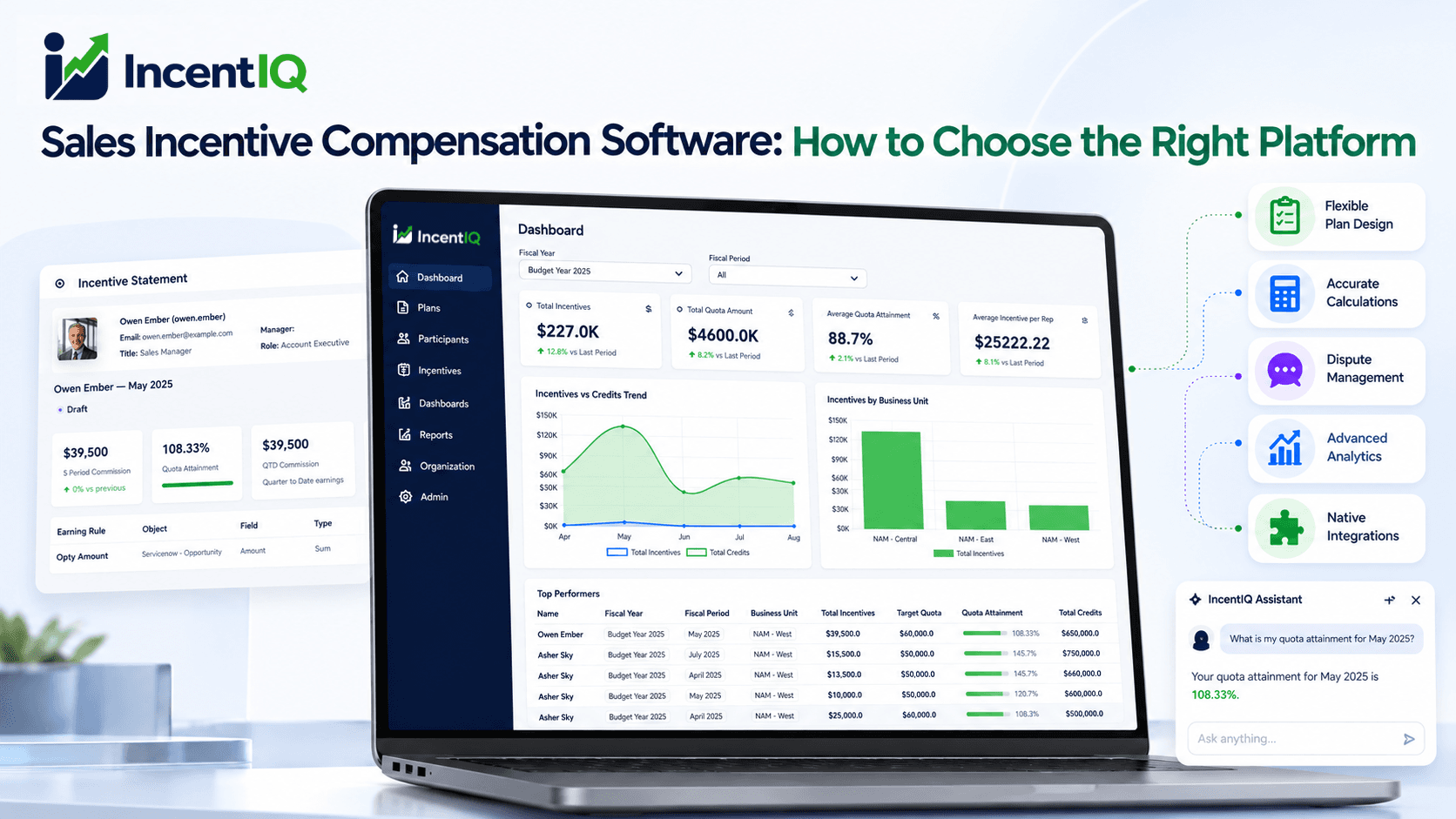
IncentIQ is an AI-first Incentive Compensation Management platform built natively on ServiceNow for enterprise-scale organizations.
By bringing incentive management into the ServiceNow environment, organizations can connect compensation processes with existing enterprise workflows, data, governance, and employee experiences.
The goal is not simply to automate calculations. It is to create a more connected approach to plan management, calculation, approvals, performance visibility, and incentive administration.
Conclusion
Choosing the right Sales Incentive Compensation Software requires organizations to look beyond basic commission calculations. Flexibility, automation, integration, transparency, security, and scalability all play an important role in selecting a long-term solution.
For enterprises looking to modernize incentive management, IncentIQ provides an AI-first approach designed around enterprise-scale compensation processes and the ServiceNow platform.
The right Sales Incentive Software can transform incentive compensation from a spreadsheet-driven administrative process into a more automated, transparent, and strategic business function.
The takeaway
IncentIQ brings incentive data, calculations, and AI into one governed system on  — so compensation is transparent, intelligent, and trusted at enterprise scale.